
Written Structure Quiz
Read Full Instruction by Clicking the above Image
Complete Reading Comprehension Test
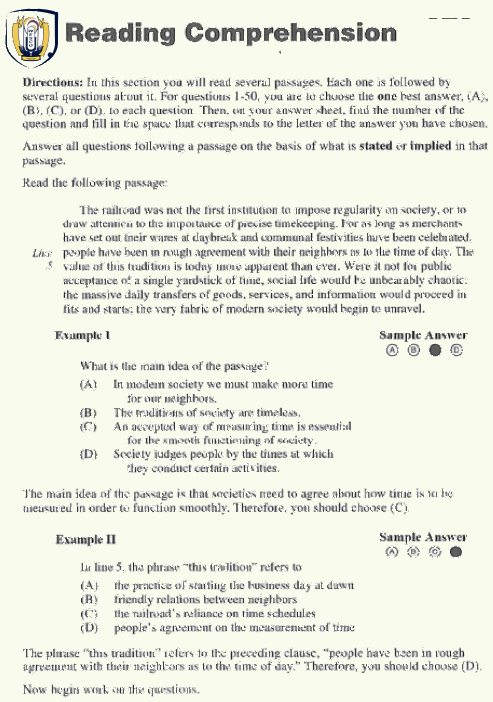
Directions: You will read several passages. Each one is followed by a set of questions. Choose the best answer (A, B, C, or D) to each question. When you finish, click "Submit All Answers" at the bottom to see your total score.
Passage 1 — Questions 1-9
Passage:
Famed architect Frank Lloyd Wright (1867–1959) created innovative structures and influenced architecture in his native United States and worldwide. Throughout his long life Wright’s restless imagination and accumulating experience led to a constant renewal of his vision. In industrial and public buildings, he was a pathfinder with radical solutions to different problems in design and construction. His new approach to the timeless but ever-changing requirements of human shelter cleared the way for others to follow his lead.
About the turn of the twentieth century, Wright introduced what quickly became known as his Prairie houses. These low-lying structures, cunningly adapted to their sites in the flat Midwestern soil, became the essence of architecture. Wright completely eliminated the boxlike arrangement of rooms that had for so long been standard building practice, opening the interior into a free-flowing series of spaces, doing away with what he considered unnecessary partitions and doors. He used light and space as the equivalent of traditional building materials. At the same time, Wright shunned the application of color and form and ornament, never using materials other than colors and textures of wood and stone with uncalled-for embellishment. As the writer Henry James observed of one of these structures, it was a house “all beautiful with omissions.”
Wright considered the furnishings and other domestic equipment of his houses integral elements of his architectural program. Wherever possible he chose to do away with fixtures of every kind and to incorporate into the architecture all means of lighting, heating, and ventilating. That program was made more practical by such advances in domestic technology as central heating and electricity. Except as ornamental and gracious accessories, the fireplace and the candle had long since headed the way of the parlor and the outhouse—toward obsolescence. Wright believed that the furniture that cluttered the average interior was quite unnecessary. The furniture he designed for his houses used forms that are architectonic—relentlessly rational. Even his occasional upholstered, freestanding seating furniture follows the strong horizontal and vertical lines of his architecture, rather than the curved lines of the human body.
Famed architect Frank Lloyd Wright (1867–1959) created innovative structures and influenced architecture in his native United States and worldwide. Throughout his long life Wright’s restless imagination and accumulating experience led to a constant renewal of his vision. In industrial and public buildings, he was a pathfinder with radical solutions to different problems in design and construction. His new approach to the timeless but ever-changing requirements of human shelter cleared the way for others to follow his lead.
About the turn of the twentieth century, Wright introduced what quickly became known as his Prairie houses. These low-lying structures, cunningly adapted to their sites in the flat Midwestern soil, became the essence of architecture. Wright completely eliminated the boxlike arrangement of rooms that had for so long been standard building practice, opening the interior into a free-flowing series of spaces, doing away with what he considered unnecessary partitions and doors. He used light and space as the equivalent of traditional building materials. At the same time, Wright shunned the application of color and form and ornament, never using materials other than colors and textures of wood and stone with uncalled-for embellishment. As the writer Henry James observed of one of these structures, it was a house “all beautiful with omissions.”
Wright considered the furnishings and other domestic equipment of his houses integral elements of his architectural program. Wherever possible he chose to do away with fixtures of every kind and to incorporate into the architecture all means of lighting, heating, and ventilating. That program was made more practical by such advances in domestic technology as central heating and electricity. Except as ornamental and gracious accessories, the fireplace and the candle had long since headed the way of the parlor and the outhouse—toward obsolescence. Wright believed that the furniture that cluttered the average interior was quite unnecessary. The furniture he designed for his houses used forms that are architectonic—relentlessly rational. Even his occasional upholstered, freestanding seating furniture follows the strong horizontal and vertical lines of his architecture, rather than the curved lines of the human body.
 English
  Français